IMPACT: Unterschied zwischen den Versionen
Keine Bearbeitungszusammenfassung |
BG (Diskussion | Beiträge) Keine Bearbeitungszusammenfassung Markierung: Quelltext-Bearbeitung 2017 |
||
| (14 dazwischenliegende Versionen von 2 Benutzern werden nicht angezeigt) | |||
| Zeile 1: | Zeile 1: | ||
{{DG HochN-Wiki Inhalt | |||
|wikikat=Projekt,IMPACT | |||
|beschr=[https://impactforaction.eu IMP>ACT] aims to understand what learners truly gain from Sustainability and Climate Change Education (SCCE)’ and how it shapes their mindsets and actions. As SCCE is still relatively new in the EU context there is still a lack of understanding of what effective SCCE looks like and how its impact can be measured. As a result, an evidence base to inform decisions for further development of programs and policies is still lacking. To drive assessment of these impacts within but also beyond education (in the wider economy and society), our overall objective is to develop the IMP>ACT assessment framework, tailored to users’ needs in SCCE policy and practice. | |||
The project and it's scope are explained in the following short video. | |||
https://www.youtube.com/watch?v=AF2PkoHDpak | |||
|thema=Nachhaltigkeit, Lehre | |||
|zielgr=Forschende, Lehrende, Forschungsförderer | |||
|kat=Hochschule,IMPACT,Projekt,Nachhaltigkeitsberichterstattung,Nachhaltige Entwicklung,Lehre | |||
}} | |||
<div class="res-img">[[Datei:Impact Logo.png|rahmenlos|link=|500px]]</div> | <div class="res-img">[[Datei:Impact Logo.png|rahmenlos|link=|500px]]</div> | ||
'''Impact Assessment for action competence (IMP>ACT)''' | '''Impact Assessment for action competence (IMP>ACT)''' | ||
'' | ''A journey towards understanding and enhancing sustainability and climate change education (SCCE).'' | ||
{{Expander|Deutsch|Im Januar 2024 ist das europäische Projekt IMP>ACT gestartet. Es zielt darauf ab, ein Verständnis darüber zu erhalten, welche Kompetenzen Lernende wirklich aus Klimabildung und Bildung für Nachhaltige Entwicklung erhalten, und wie dies ihre Denkweisen und Handlungen prägt. Da BNE im EU-Kontext noch relativ neu ist, besteht noch kein übergreifendes Verständnis davon, wie effektive BNE aussehen könnte und wie ihre Auswirkungen gemessen werden können. Deshalb verfolgt das Projekt die Entwicklung eines Bewertungsrahmens, der dazu beiträgt die Auswirkungen von BNE und vor allem die erworbene Handlungskompetenz der Studierenden zu evaluieren. Als Societal Partner darf die DG HochN an der Überprüfung und Anwendung des Bewertungsrahmens in Deutschland im Hochschulkontext aktiv mitwirken. | |||
}} | |||
<br> | |||
==Overview: Introducing the project and the consortium== | |||
The project runs from 01.01.2024 to 31.12.2027. IMP>ACT brings together an interdisciplinary consortium with partners from SCCE research, policy and practice. In each country a national stakeholder group (35 committed organisations) actively co-develops and validates the IMP>ACT assessment framework, contributing to its validity and viability beyond the project’s lifetime. | |||
The IMP>ACT assessment framework will allow designers and implementers of SCCE policies, curricula and practices to collect information on the impact they achieve, and as such drive improved feedback loops between research, policy and practice. This will ensure that SCCE materials, tools, interventions, and curricula stay relevant, and lead to evidence-based quality improvement of SCCE policies and practices. | |||
In addition to five Academic Partners, six Societal Partners are working on the project. | |||
{{Expander|Deutsch|Das Projekt läuft vom 01.01.2024 bis zum 31.12.2027. IMP>ACT bringt ein interdisziplinäres Konsortium mit Partner:innen aus Forschung, Politik und Praxis der BNE und Klimabildung zusammen. In jedem Land arbeitet eine nationale Interessengruppe (35 engagierte Organisationen) aktiv an der Entwicklung und Validierung des IMP>ACT-Bewertungsrahmens mit und trägt so zu dessen Gültigkeit und Durchführbarkeit über die Projektlaufzeit hinaus bei. | |||
Der IMP>ACT-Bewertungsrahmen wird es den Entwickler:innen und Anwender:innen von BNE- und Klimabildungsmaßnahmen, -Lehrplänen und -Praktiken ermöglichen, Informationen über die von ihnen erzielten Wirkungen zu sammeln und so verbesserte Rückkopplungsschleifen zwischen Forschung, Politik und Praxis zu fördern. Dadurch wird sichergestellt, dass die Materialien, Instrumente, Interventionen und Lehrpläne für die BNE und Klimabildung relevant bleiben und zu einer evidenzbasierten Qualitätsverbesserung der BNE- und Klimabildungspolitik und -Praxis führen. | |||
Zusätzlich zu den fünf akademischen Partnern arbeiten sechs gesellschaftliche Partner an dem Projekt. | |||
}} | |||
<br> | |||
===Academic Partners=== | |||
*Utrecht University (NL) | |||
*Karlstad University (SE) | |||
*University of Vechta (DE) | |||
*University of Antwerp (BE) | |||
*Masarykova University (CZ) | |||
===Societal Partners=== | |||
*National Institute for the Evaluation of the Educational System of Education and Training (IT) | |||
*Centre for the Promotion of Science (RS) | |||
*Keep Sweden Tidy Foundation (SE) | |||
*Deutsche Gesellschaft für Nachhaltigkeit an Hochschulen e.V. (DE) | |||
*Flamish Government (BE) | |||
*JUNAK - Czech Scout, Scouting Institute (ZS) | |||
==Role of the DG HochN== | |||
As a societal partner, DG HochN has a role as described below. | |||
The IMP>ACT societal partners, are fully involved in all work packages of the project. Together with the research partners they provide input and feedback on the conceptualisation and operationalisation of the framework, facilitate the identification and evaluation of interventions, apply the IMP>ACT assessment framework in six case studies around the SCCE policies and practices within their own organisations, provide input for the validation of the framework, and leverage their networks and activities towards the exploitation of results. | |||
In each participating country a National Stakeholder Group (NSG) has already been set up. These groups have representatives of all target audiences: public bodies (policymakers, educational professionals, professionals in large-scale assessments), civil society (educational network organisations, NGOs,), and student organisations as well as individual scientists and educators. 35 organisations are already committed to IMP>ACT. The NSGs will be involved throughout the project to identify relevant policies, as sounding boards and/or participants in interventions and case studies, reflect on preliminary results and co-produce policy briefs and recommendations. The active involvement and contribution of these stakeholders in the NSGs will ensure the viability of IMP>ACT’s results beyond the project’s lifetime. | |||
{{Expander|Deutsch|Als gesellschaftliche Partnerin hat die DG HochN folgende Rolle. | |||
Die gesellschaftlichen Partner:innen von IMP>ACT sind in alle Arbeitspakete des Projekts eingebunden. Gemeinsam mit den Forschungspartner:innen liefern sie Input und Feedback zur Konzeptualisierung und Operationalisierung des Bewertungsrahmens. Sie erleichtern außerdem die Identifizierung und Bewertung von Interventionen und wenden den IMP>ACT-Bewertungsrahmen in sechs Fallstudien zu den Strategien und Praktiken der BNE und Klimabildung in ihren eigenen Organisationen an. Dadurch liefern die gesellschaftlichen Partner:innen Input für die Validierung des Rahmens und verbreiten die Ergebnisse der Bewertungen in ihren Netzwerken. | |||
In jedem teilnehmenden Land wurde eine nationale Interessengruppe (NSG) eingerichtet, in der verschiedene Zielgruppen vertreten sind: öffentliche Einrichtungen (politische Entscheidungsträger:innen, Bildungsfachleute), die Zivilgesellschaft (Bildungsnetzwerke, Nichtregierungsorganisationen) und Studentenorganisationen sowie einzelne Wissenschaftler:innen und Pädagog:innen. 35 Organisationen haben sich dazu bereiterklärt den IMP>ACT-Bewertungsrahmen zu nutzen. Die NSG werden während des gesamten Projekts einbezogen, um relevante politische Maßnahmen zu ermitteln, als Resonanzboden und/oder Teilnehmer:innen an Interventionen und Fallstudien zu fungieren, über vorläufige Ergebnisse zu reflektieren und bei der Erstellung von politischen Kurzdarstellungen und Empfehlungen zu unterstützen. Die aktive Beteiligung und der Beitrag dieser Interessengruppen in den NSGs wird die Tragfähigkeit der Ergebnisse des IMP>ACT-Bewertungsrahmens über die Projektlaufzeit hinaus sicherstellen. | |||
}} | }} | ||
<br> | |||
==Background Information== | |||
===Objectives=== | |||
At the core of the IMP>ACT assessment framework are the concepts of action competence (key observable learning outcome of SCCE) and action-orientation (key qualities of teaching, driving learning in SCCE). IMP>ACT will design and validate the framework in a user-centred, iterative approach through small-scale interventions, followed by six large-scale case studies,selected to cover the lifelong learning scope of SCCE. IMP>ACT brings together an interdisciplinary consortium with partners from SCCE research, policy and practice. | |||
{{ | {{Expander|Deutsch|Im Mittelpunkt des IMP>ACT-Bewertungsrahmens steht die Handlungskompetenz (als wichtigstes Lernergebnis von BNE und Klimabildung) und die Handlungsorientierung (als Schlüsselkompetenz bei Lernenden). IMP>ACT wird den Bewertungsrahmen in einem nutzer:innenzentrierten, iterativen Ansatz durch kleine Interventionen entwickeln und validieren, gefolgt von sechs groß angelegten Fallstudien, die so ausgewählt wurden, dass sie den Bereich des lebenslangen Lernens im Bereich BNE und Klimabildung abdecken. Dabei bringt IMP>ACT ein interdisziplinäres Konsortium bestehend aus Partner:innen aus Forschung, Politik und Praxis zusammen. | ||
}} | }} | ||
<br> | |||
====Action Competence==== | |||
*"Commitment, willingness and ability to take action" | |||
*"All actions are behaviors, but not all behaviors are actions" | |||
[[Datei:Sustainability-11-05994-g003-550.pdf|mini|link=https://wiki.dg-hochn.de/images/7/78/Sustainability-11-05994-g003-550.pdf|alt=(Mogensen & Schnack, 2010, Sass et al., 2020)]] | |||
'''Action:''' | |||
*Decided upon by those who act | |||
*Comes from a commitment to/ connection with a controversial issue | |||
*Deliberated and intended as a contribution to solving that issue | |||
(Sinakou et al., 2019, Van Poeck et al., 2023) | |||
====More readings on action competence==== | |||
*Sinakou, Donche, Boeve-de Pauw, & Van Petegem. (2019). Designing Powerful Learning Environments in Education for Sustainable Development: A Conceptual Framework. Sustainability, 11(21), 5994. https://doi.org/10.3390/su11215994 | |||
*Sass, W., De Maeyer, S., Boeve-de Pauw, J., & Van Petegem, P. (2024). Effectiveness of education for sustainability: The importance of an action-oriented approach. Environmental Education Research, 30(4), 479–498. https://doi.org/10.1080/13504622.2023.2229543 | |||
*Sass, W., Boeve-de Pauw, J., Olsson, D., Gericke, N., De Maeyer, S., & Van Petegem, P. (2020). Redefining action competence: The case of sustainable development. The Journal of Environmental Education, 51(4), 292–305. https://doi.org/10.1080/00958964.2020.1765132 | |||
*Schönstein, R. F., & Budke, A. (2024). Teaching action competence in education for sustainable development – a qualitative study on teachers’ ideas, opinions, attitudes and self-conceptions. Frontiers in Education, 8, 1256849. https://doi.org/10.3389/feduc.2023.1256849 | |||
*European Commission. Joint Research Centre. (2020). Sustainability competences: A systematic literature review. Publications Office. https://data.europa.eu/doi/10.2760/200956 | |||
===Methodology=== | |||
IMP>ACT applies a participatory design approach to its research and development activities, including relevant knowledge actors and users by means of co-design, co-creation and co-assessment. Through participatory design research, we aim to engage these stakeholders in the design process of the IMP>ACT assessment framework, to ensure that the framework is effective, relevant, and inclusive of their contexts and needs. Our approach to participatory design research involves identifying and recruiting stakeholders, co-designing research questions, collecting, analysing, and interpreting data, knowledge dissemination, and enacting change. | |||
{{Expander|Deutsch|IMP>ACT wendet bei seinen Forschungs- und Entwicklungsaktivitäten einen partizipativen Designansatz an, der relevante Wissensakteur:innen und Nutzer:innen durch Co-Design, Co-Kreation und Co-Assessment einbezieht. Durch partizipative Designforschung wollen wir diese Interessengruppen in den Designprozess des IMP>ACT-Bewertungsrahmens integrieren, um sicherzustellen, dass der Rahmen effektiv ist und die Kontexte sowie Bedürfnisse der Interessengruppen berücksichtigt werden. Unser Ansatz der partizipativen Designforschung umfasst die Identifizierung und Rekrutierung von relevanten Stakeholdern, die Mitgestaltung von Forschungsfragen, das Sammeln, Analysieren und Interpretieren von Daten, die Wissensverbreitung und das Vorantreiben eines Wandels. | |||
}} | }} | ||
<br> | |||
==Links== | |||
* [https://impactforaction.eu IMP>ACT project webpage] | |||
* [https://www.linkedin.com/company/the-imp-act-project/posts/?feedView=all IMP>ACT project on LinkedIn] | |||
* [https://www.youtube.com/watch?v=AF2PkoHDpak Introduction video] | |||
[[Kategorie: Projekt]][[Kategorie:IMPACT]][[Kategorie:Lehre]] | |||
<div align="right"><small></small> | <div align="right"><small></small> | ||
<div class="res-img">[[Datei:EN fundedbyEU VERTICAL RGB POS.png|rahmenlos|link=|150px]] | <div class="res-img">[[Datei:EN fundedbyEU VERTICAL RGB POS.png|rahmenlos|link=|150px]] | ||
</div> | </div> | ||
Aktuelle Version vom 10. November 2025, 17:44 Uhr
IMP>ACT aims to understand what learners truly gain from Sustainability and Climate Change Education (SCCE)’ and how it shapes their mindsets and actions. As SCCE is still relatively new in the EU context there is still a lack of understanding of what effective SCCE looks like and how its impact can be measured. As a result, an evidence base to inform decisions for further development of programs and policies is still lacking. To drive assessment of these impacts within but also beyond education (in the wider economy and society), our overall objective is to develop the IMP>ACT assessment framework, tailored to users’ needs in SCCE policy and practice.
The project and it's scope are explained in the following short video. https://www.youtube.com/watch?v=AF2PkoHDpak
| IMPACT | |
|---|---|
| Kategorie | |
Projekt , IMPACT
| |
| Thematisch verbunden mit | |
| Zielgruppe | |
Forschende, Lehrende, Forschungsförderer
|
Impact Assessment for action competence (IMP>ACT)
A journey towards understanding and enhancing sustainability and climate change education (SCCE).
Im Januar 2024 ist das europäische Projekt IMP>ACT gestartet. Es zielt darauf ab, ein Verständnis darüber zu erhalten, welche Kompetenzen Lernende wirklich aus Klimabildung und Bildung für Nachhaltige Entwicklung erhalten, und wie dies ihre Denkweisen und Handlungen prägt. Da BNE im EU-Kontext noch relativ neu ist, besteht noch kein übergreifendes Verständnis davon, wie effektive BNE aussehen könnte und wie ihre Auswirkungen gemessen werden können. Deshalb verfolgt das Projekt die Entwicklung eines Bewertungsrahmens, der dazu beiträgt die Auswirkungen von BNE und vor allem die erworbene Handlungskompetenz der Studierenden zu evaluieren. Als Societal Partner darf die DG HochN an der Überprüfung und Anwendung des Bewertungsrahmens in Deutschland im Hochschulkontext aktiv mitwirken.
Overview: Introducing the project and the consortium
The project runs from 01.01.2024 to 31.12.2027. IMP>ACT brings together an interdisciplinary consortium with partners from SCCE research, policy and practice. In each country a national stakeholder group (35 committed organisations) actively co-develops and validates the IMP>ACT assessment framework, contributing to its validity and viability beyond the project’s lifetime.
The IMP>ACT assessment framework will allow designers and implementers of SCCE policies, curricula and practices to collect information on the impact they achieve, and as such drive improved feedback loops between research, policy and practice. This will ensure that SCCE materials, tools, interventions, and curricula stay relevant, and lead to evidence-based quality improvement of SCCE policies and practices.
In addition to five Academic Partners, six Societal Partners are working on the project.
Das Projekt läuft vom 01.01.2024 bis zum 31.12.2027. IMP>ACT bringt ein interdisziplinäres Konsortium mit Partner:innen aus Forschung, Politik und Praxis der BNE und Klimabildung zusammen. In jedem Land arbeitet eine nationale Interessengruppe (35 engagierte Organisationen) aktiv an der Entwicklung und Validierung des IMP>ACT-Bewertungsrahmens mit und trägt so zu dessen Gültigkeit und Durchführbarkeit über die Projektlaufzeit hinaus bei.
Der IMP>ACT-Bewertungsrahmen wird es den Entwickler:innen und Anwender:innen von BNE- und Klimabildungsmaßnahmen, -Lehrplänen und -Praktiken ermöglichen, Informationen über die von ihnen erzielten Wirkungen zu sammeln und so verbesserte Rückkopplungsschleifen zwischen Forschung, Politik und Praxis zu fördern. Dadurch wird sichergestellt, dass die Materialien, Instrumente, Interventionen und Lehrpläne für die BNE und Klimabildung relevant bleiben und zu einer evidenzbasierten Qualitätsverbesserung der BNE- und Klimabildungspolitik und -Praxis führen.
Zusätzlich zu den fünf akademischen Partnern arbeiten sechs gesellschaftliche Partner an dem Projekt.
Academic Partners
- Utrecht University (NL)
- Karlstad University (SE)
- University of Vechta (DE)
- University of Antwerp (BE)
- Masarykova University (CZ)
Societal Partners
- National Institute for the Evaluation of the Educational System of Education and Training (IT)
- Centre for the Promotion of Science (RS)
- Keep Sweden Tidy Foundation (SE)
- Deutsche Gesellschaft für Nachhaltigkeit an Hochschulen e.V. (DE)
- Flamish Government (BE)
- JUNAK - Czech Scout, Scouting Institute (ZS)
Role of the DG HochN
As a societal partner, DG HochN has a role as described below.
The IMP>ACT societal partners, are fully involved in all work packages of the project. Together with the research partners they provide input and feedback on the conceptualisation and operationalisation of the framework, facilitate the identification and evaluation of interventions, apply the IMP>ACT assessment framework in six case studies around the SCCE policies and practices within their own organisations, provide input for the validation of the framework, and leverage their networks and activities towards the exploitation of results.
In each participating country a National Stakeholder Group (NSG) has already been set up. These groups have representatives of all target audiences: public bodies (policymakers, educational professionals, professionals in large-scale assessments), civil society (educational network organisations, NGOs,), and student organisations as well as individual scientists and educators. 35 organisations are already committed to IMP>ACT. The NSGs will be involved throughout the project to identify relevant policies, as sounding boards and/or participants in interventions and case studies, reflect on preliminary results and co-produce policy briefs and recommendations. The active involvement and contribution of these stakeholders in the NSGs will ensure the viability of IMP>ACT’s results beyond the project’s lifetime.
Als gesellschaftliche Partnerin hat die DG HochN folgende Rolle.
Die gesellschaftlichen Partner:innen von IMP>ACT sind in alle Arbeitspakete des Projekts eingebunden. Gemeinsam mit den Forschungspartner:innen liefern sie Input und Feedback zur Konzeptualisierung und Operationalisierung des Bewertungsrahmens. Sie erleichtern außerdem die Identifizierung und Bewertung von Interventionen und wenden den IMP>ACT-Bewertungsrahmen in sechs Fallstudien zu den Strategien und Praktiken der BNE und Klimabildung in ihren eigenen Organisationen an. Dadurch liefern die gesellschaftlichen Partner:innen Input für die Validierung des Rahmens und verbreiten die Ergebnisse der Bewertungen in ihren Netzwerken.
In jedem teilnehmenden Land wurde eine nationale Interessengruppe (NSG) eingerichtet, in der verschiedene Zielgruppen vertreten sind: öffentliche Einrichtungen (politische Entscheidungsträger:innen, Bildungsfachleute), die Zivilgesellschaft (Bildungsnetzwerke, Nichtregierungsorganisationen) und Studentenorganisationen sowie einzelne Wissenschaftler:innen und Pädagog:innen. 35 Organisationen haben sich dazu bereiterklärt den IMP>ACT-Bewertungsrahmen zu nutzen. Die NSG werden während des gesamten Projekts einbezogen, um relevante politische Maßnahmen zu ermitteln, als Resonanzboden und/oder Teilnehmer:innen an Interventionen und Fallstudien zu fungieren, über vorläufige Ergebnisse zu reflektieren und bei der Erstellung von politischen Kurzdarstellungen und Empfehlungen zu unterstützen. Die aktive Beteiligung und der Beitrag dieser Interessengruppen in den NSGs wird die Tragfähigkeit der Ergebnisse des IMP>ACT-Bewertungsrahmens über die Projektlaufzeit hinaus sicherstellen.
Background Information
Objectives
At the core of the IMP>ACT assessment framework are the concepts of action competence (key observable learning outcome of SCCE) and action-orientation (key qualities of teaching, driving learning in SCCE). IMP>ACT will design and validate the framework in a user-centred, iterative approach through small-scale interventions, followed by six large-scale case studies,selected to cover the lifelong learning scope of SCCE. IMP>ACT brings together an interdisciplinary consortium with partners from SCCE research, policy and practice.
Im Mittelpunkt des IMP>ACT-Bewertungsrahmens steht die Handlungskompetenz (als wichtigstes Lernergebnis von BNE und Klimabildung) und die Handlungsorientierung (als Schlüsselkompetenz bei Lernenden). IMP>ACT wird den Bewertungsrahmen in einem nutzer:innenzentrierten, iterativen Ansatz durch kleine Interventionen entwickeln und validieren, gefolgt von sechs groß angelegten Fallstudien, die so ausgewählt wurden, dass sie den Bereich des lebenslangen Lernens im Bereich BNE und Klimabildung abdecken. Dabei bringt IMP>ACT ein interdisziplinäres Konsortium bestehend aus Partner:innen aus Forschung, Politik und Praxis zusammen.
Action Competence
- "Commitment, willingness and ability to take action"
- "All actions are behaviors, but not all behaviors are actions"
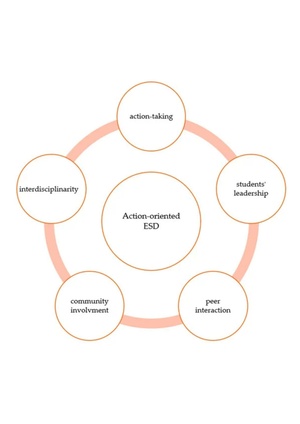
Action:
- Decided upon by those who act
- Comes from a commitment to/ connection with a controversial issue
- Deliberated and intended as a contribution to solving that issue
(Sinakou et al., 2019, Van Poeck et al., 2023)
More readings on action competence
- Sinakou, Donche, Boeve-de Pauw, & Van Petegem. (2019). Designing Powerful Learning Environments in Education for Sustainable Development: A Conceptual Framework. Sustainability, 11(21), 5994. https://doi.org/10.3390/su11215994
- Sass, W., De Maeyer, S., Boeve-de Pauw, J., & Van Petegem, P. (2024). Effectiveness of education for sustainability: The importance of an action-oriented approach. Environmental Education Research, 30(4), 479–498. https://doi.org/10.1080/13504622.2023.2229543
- Sass, W., Boeve-de Pauw, J., Olsson, D., Gericke, N., De Maeyer, S., & Van Petegem, P. (2020). Redefining action competence: The case of sustainable development. The Journal of Environmental Education, 51(4), 292–305. https://doi.org/10.1080/00958964.2020.1765132
- Schönstein, R. F., & Budke, A. (2024). Teaching action competence in education for sustainable development – a qualitative study on teachers’ ideas, opinions, attitudes and self-conceptions. Frontiers in Education, 8, 1256849. https://doi.org/10.3389/feduc.2023.1256849
- European Commission. Joint Research Centre. (2020). Sustainability competences: A systematic literature review. Publications Office. https://data.europa.eu/doi/10.2760/200956
Methodology
IMP>ACT applies a participatory design approach to its research and development activities, including relevant knowledge actors and users by means of co-design, co-creation and co-assessment. Through participatory design research, we aim to engage these stakeholders in the design process of the IMP>ACT assessment framework, to ensure that the framework is effective, relevant, and inclusive of their contexts and needs. Our approach to participatory design research involves identifying and recruiting stakeholders, co-designing research questions, collecting, analysing, and interpreting data, knowledge dissemination, and enacting change.
IMP>ACT wendet bei seinen Forschungs- und Entwicklungsaktivitäten einen partizipativen Designansatz an, der relevante Wissensakteur:innen und Nutzer:innen durch Co-Design, Co-Kreation und Co-Assessment einbezieht. Durch partizipative Designforschung wollen wir diese Interessengruppen in den Designprozess des IMP>ACT-Bewertungsrahmens integrieren, um sicherzustellen, dass der Rahmen effektiv ist und die Kontexte sowie Bedürfnisse der Interessengruppen berücksichtigt werden. Unser Ansatz der partizipativen Designforschung umfasst die Identifizierung und Rekrutierung von relevanten Stakeholdern, die Mitgestaltung von Forschungsfragen, das Sammeln, Analysieren und Interpretieren von Daten, die Wissensverbreitung und das Vorantreiben eines Wandels.
Links